

Extension – RECAP: Relational Communication in Dementia Care
Learnings from IDC 2026 and extension of the RECAP framework
Introductory Summary
“Communication is not a soft skill. It is part of the care system.”
Handout 1
Handout 1 introduced RECAP as a practical, rights-based framework for supporting identity, autonomy, and inclusion for older adults from culturally and linguistically diverse (CALD) backgrounds.
Handout 2
Handout 2 extends the framework through learnings from the International Dementia Conference 2026. It reflects how dialogue across dementia research, practice, lived experience, and system transformation deepened the RECAP model.
The extension positions RECAP as more than a communication framework. It presents RECAP as a system integration model that connects relational care with service design, moves from access to participation, and supports equitable engagement across diverse populations, including CALD communities.
How to use this handout:
- use in team reflection
- use in dementia care training
- use in care planning / communication review
- use in CALD service design
- use in quality improvement discussion
RECAP as a system integration model
Why this extension matters
Dementia care is advancing through prevention, early diagnosis, personalised interventions, and new models of care. Yet communication is not always embedded as the mechanism through which people access, understand, and experience those advances.
The RECAP extension argues that communication must be designed as part of the care system itself. Without relational communication, innovation can become unevenly accessible.
The extension was informed by post-conference reflection on two major IDC contributions.
- Dr G. Allen Power’s well-being approach strengthened RECAP’s relational focus by showing how behaviour can signal unmet well-being domains.
- Prof. Craig Ritchie’s prevention and system transformation lens highlighted that future dementia care depends on early engagement, service navigation, risk understanding, and trust.
The three arguments behind the RECAP extension
Argument 1: Communication restores well-being
Communication in dementia care is not simply the exchange of information. It is relational, interpretive, and meaning making.
Through RECAP, communication becomes a means of restoring well-being, not simply responding to behaviour.
Argument 2: Access is relationally mediated
Access to care is not determined only by service availability. Access is mediated through relationships, trust, language, and social positioning.
Through RECAP, access becomes enabled, not assumed.
This is particularly important for CALD communities because prevention, diagnosis, and support pathways often assume that people can understand information, engage early, and navigate systems safely. RECAP asks whether these assumptions hold when language, culture, trust, and relational safety are not designed into the pathway.
Argument 3: Communication is system infrastructure
If communication is not designed to restore well-being and enable relational, cultural, and system level understanding, advances in dementia care risk improving systems without improving lived experience.
What changes in practice through RECAP
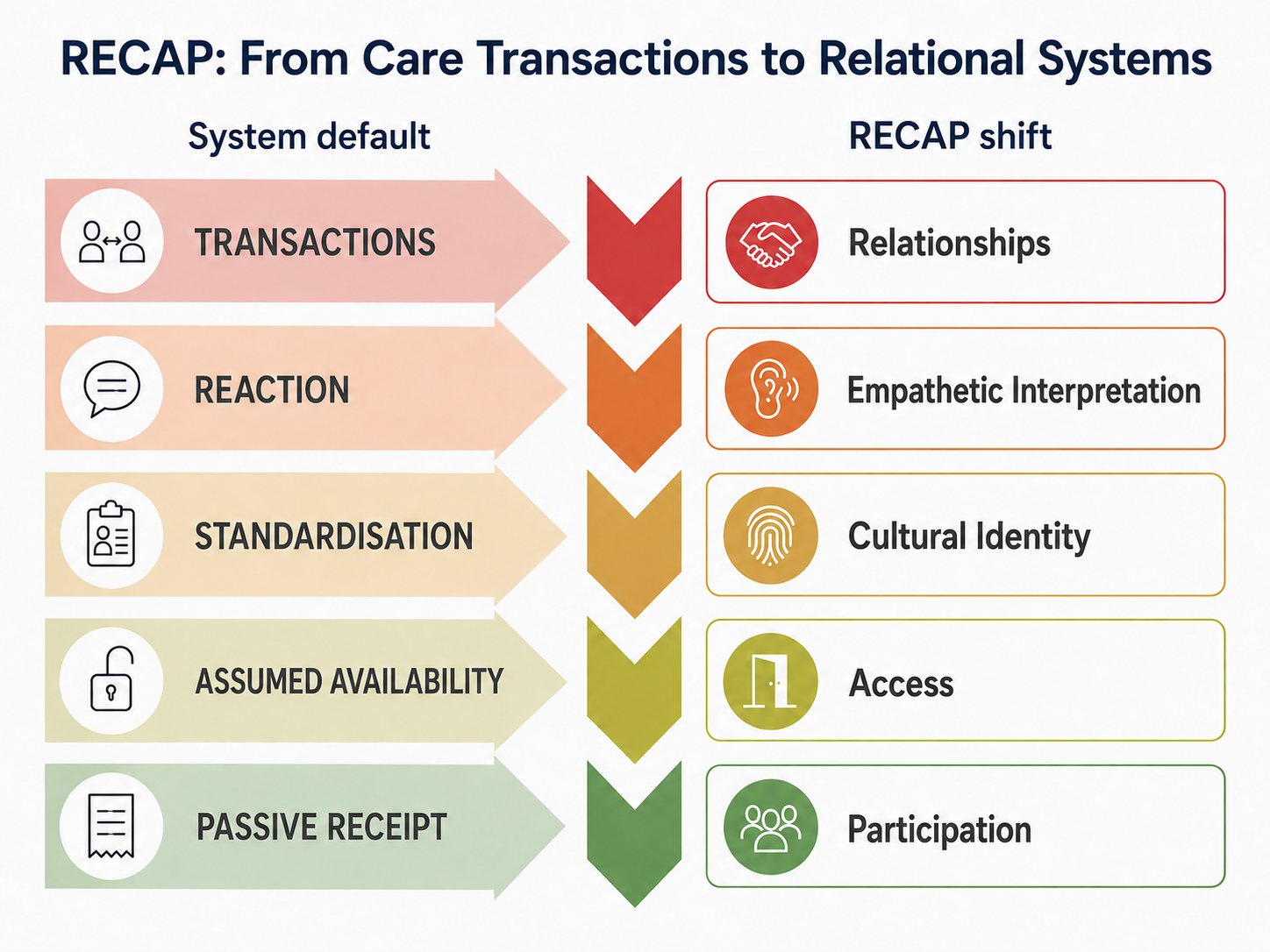
R - Relationships replace transactions
- One interaction is not enough.
- Consistent relationships sustain trust and recognition.
E - Empathic interpretation replaces reaction
- Interpret behaviour as communication.
- Recognise relational, cultural, and emotional meaning.
C - Cultural identity replaces standardisation
- Integrate cultural identity into care.
- Engage community knowledge and leadership.
A - Access replaces assumed availability
- Enable access through language and interpreter engagement.
- Design systems people can understand and navigate.
P - Participation replaces passive receipt
- Enable informed and meaningful participation.
- Support autonomy through communication.
Downloadable Handout 2
This downloadable resource accompanies the RECAP Handout 1 resource and extends the model through IDC 2026 learnings. Handout 2 should be read together with Handout 1. Handout 1 introduces the RECAP framework. Handout 2 extends the framework by showing how RECAP can operate as a system integration model, connecting communication practice with service design, workforce capability, and equitable participation.
RECAP Handout 2: IDC 2026 Learnings and Framework Extension
Download:
RECAP Handout 2: IDC 2026 Learnings and Framework Extension
Chudecka, A. (2026). RECAP: Relational communication in dementia care. Handout 2: Extension of the RECAP framework informed by International Dementia Conference 2026. Multicultural Aged Care Inc. (MAC) / PICAC Alliance.
Bibliography
Key References
- Chudecka, A. (2026). RECAP: Relational communication in dementia care. Handout 1:
Supporting identity, autonomy and inclusion for CALD older adults. Multicultural Aged Care
Inc. (MAC) / PICAC Alliance. - Chudecka, A., Xiao, L. D., & Muller, A. (n.d.). Older migrants, language and access to care: A
qualitative systematic review [Manuscript under review].
- Liu, X., Cook, G., & Cattan, M. (2017). Support networks for Chinese older immigrants
accessing English health and social care services: The concept of Bridge People. Health &
Social Care in the Community, 25(2), 667–677. https://doi.org/10.1111/hsc.12357 - Power, G. A. (2014). Dementia beyond disease: Enhancing well-being. Health Professions
Press. - Power, G. A. (2016). Dementia beyond drugs: Changing the culture of care. Health
Professions Press. - Power, G. A. (2026). Well-being approach in dementia care [Pre-conference masterclass].
International Dementia Conference 2026, Sydney, Australia. - Power, G. A. (2026). Centering the whole person in dementia care [Keynote presentation].
International Dementia Conference 2026, Sydney, Australia. - Ritchie, C. W. (2026). Brain health, prevention and system transformation in dementia care
[Conference presentation]. International Dementia Conference 2026, Sydney, Australia. - Snow, T. (n.d.). Positive Approach® to Care and GEMS® Brain Change Model. Positive
Approach to Care.
Recommended/Further Reading
- Australian Government Department of Health and Aged Care. (2024). National Dementia
Action Plan 2024–2034. https://www.health.gov.au/resources/publications/national-
dementia-action-plan-2024-2034 - Australian Government Department of Health and Aged Care. (2024). Aged Care Act 2024.
https://www.legislation.gov.au/ - Australian Government Department of Health, Disability and Ageing. (2025). National
Dementia Action Plan overview.
https://www.health.gov.au/resources/publications/national-dementia-action-plan-overview - Australian Government Department of Health, Disability and Ageing. (2026). National
Dementia Action Plan collective priority framework 2025–2027. https://www.health.gov.au/ - Brijnath, B., Cavuoto, M., Markusevska, S., & Clarke, N. (2025). Improving interpreting for
dementia assessments: The MINDSET study — National implementation (Stage 3) final
report. RMIT University. - National Accreditation Authority for Translators and Interpreters. (2023). Free dementia
training for interpreters: MINDSET project. https://www.naati.com.au/news/mindset-
dementia-interpreter-training-trial/ - National Ageing Research Institute. (2024). MINDSET Study: Improving interpreting for
dementia assessments. https://www.nari.net.au/the-mindset-study - National Ageing Research Institute. (2025). Online interpreter training improves dementia
detection [Media release]. https://www.nari.net.au/news/online-interpreter-training-
improves-dementia-detection - Translating and Interpreting Service National. (n.d.). About the service. Department of Home
Affairs. https://immi.homeaffairs.gov.au/settlement-services-subsite/Pages/tis-
national.aspx - Translating and Interpreting Service National. (n.d.). About us. Department of Home Affairs.
https://www.tisnational.gov.au/en/Who/About-us
Suggested citation for Handout 2
Chudecka, A. (2026). RECAP: Relational communication in dementia care. Handout 2:
Extension of the RECAP framework informed by International Dementia Conference 2026.
Multicultural Aged Care Inc. (MAC) / PICAC Alliance.

